











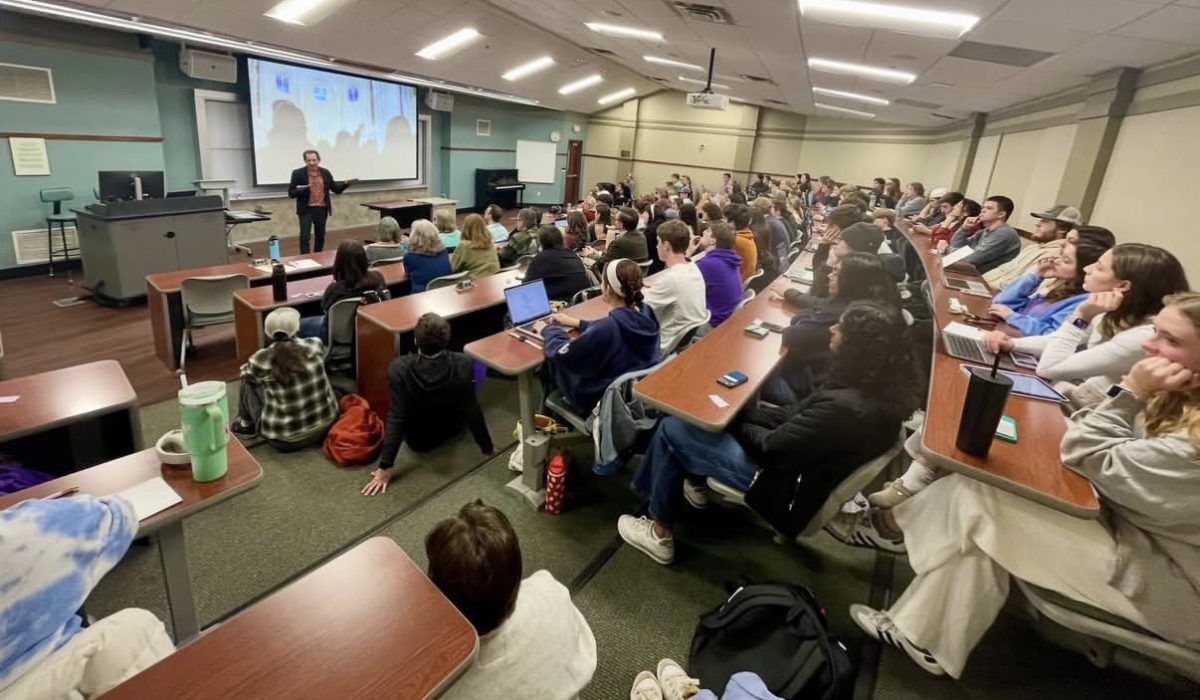








At Furman, I’ve found that political conversations tend to be shut down by an oft-repeated phrase: “I don’t care about politics because it doesn’t affect me.” You would think that students at a liberal arts college, at which the importance of dialogue is heavily emphasized, would care more about politics — but we don’t.
There are a handful of political organizations at Furman. However, they have decreased in size over recent years. College Democrats and College Republicans do not play a role in our broader campus discourse, and the Furman Conservative Society admits to “dwindling attendance numbers.” While Furman Young Democratic Socialists of America engages many students, it holds a small, largely upperclassman membership.
This decrease in political engagement is part of a greater national trend. According to a 2023 survey by the Institute for Citizens and Scholars, a civic development non-profit, civic engagement is down among American youth. 33% of surveyed individuals indicated “no intention to participate civically in 2024,” which includes “voting, political volunteerism, donating, event attendance, and digital content creation.”
Many young people disengaged during the 2024 election, citing a sense of “apathy, mistrust, and dissatisfaction with democratic processes.” That might be a fair response to our current political climate, but we’ll have to deal with reality sooner or later. Politics infects everything that we do: how much we pay in taxes, which neighborhood we live in and the cost of our tuition every year. Not caring is not a neutral position.
When you don’t care about politics, the president starts to feel it’s okay to deport your neighbors without due process. Your senator becomes comfortable inciting another war in the Middle East. Your representative in Congress, a nurse herself, becomes comfortable supporting a megabill that will inevitably strip Medicaid access from some of her constituents. Your state representative, whose name you don’t know, doesn’t mind voicing his approval of the death penalty as a response to abortion.
This also happens at a local level: your city councilman doesn’t want the homeless man, whose strength has been sapped by standing in the humidity — because he is not welcome in the downtown tourist traps — to rest his head on a park bench. The racism in city planning becomes overt when your city councilman — a different one — chooses to vote for a luxury development that will displace Black families for the sake of profit.
According to Pew Research, 65% of Americans say that they often feel exhausted when thinking about politics. 55% feel angry. And you should feel angry — mistrust in democracy is present for a reason. Instead of letting that anger become apathy, you should shift it towards community mobilization.
This could mean canvassing for a local candidate — local politics have a stronger impact than you may think. The Greenville City Council election is coming up, and the first African-American woman to graduate from Furman, Councilwoman Lillian Brock Flemming, is running for re-election. It could be as small an effort as registering to vote, volunteering at the soup kitchen or working with the local food bank. Service will always be political and should remind you of who you vote for — your community and, by extension, yourself.
The audience of this piece is, naturally, my peers. You should not become content with what is happening in the world. The cost of living will be ours to pay in the next 10 years, and a felony-holding real estate developer from New York isn’t going to fix it. Our generation is in the position to continue the work that others have left unfinished instead of perpetuating political dissatisfaction. Mobilize, speak up and don’t be afraid to align yourself with a political identity.
Nancy Grant McDaniel • Sep 25, 2025 at 4:30 pm
Excellent presentation of political views, opinions and and our rights under the first amendment of our constitution