







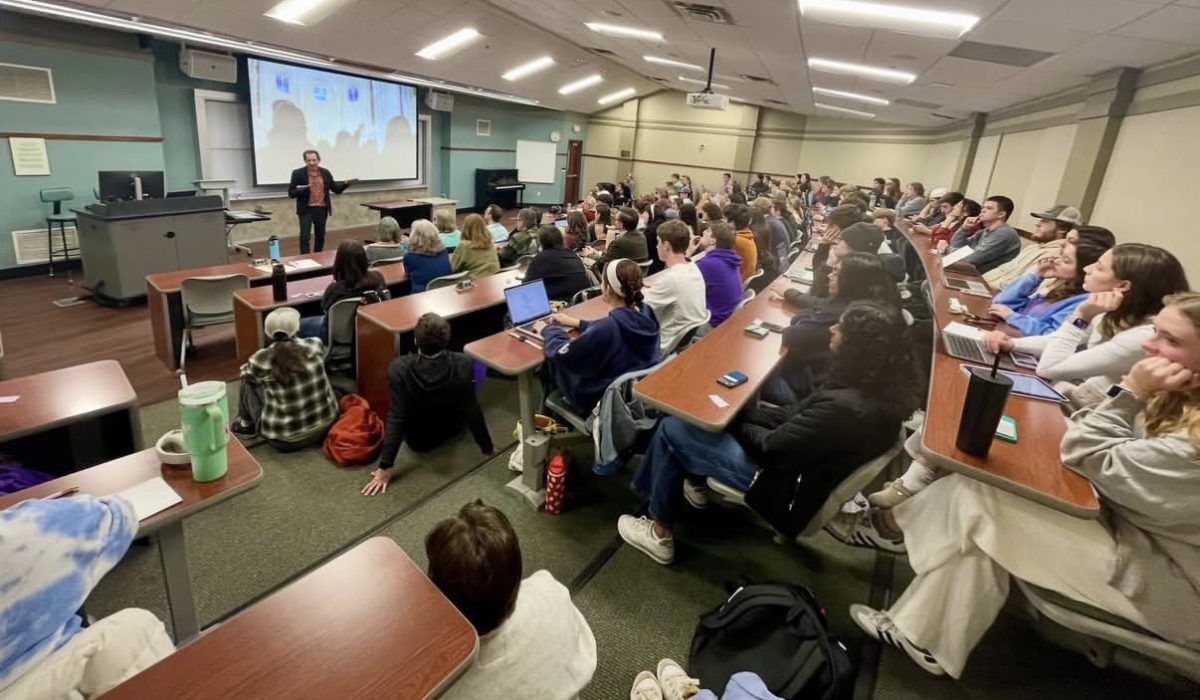







On Tuesday, Feb. 3, the Women, Gender and Sexuality Studies Department hosted its third installment of resistance-themed Cultural Life Programs (CLP). The Philosophy and Furman Humanities Center partnered to put on “Uncivil Resistance and Queer Activism,” which covered how resistance has shaped the queer liberation movement. This specific CLP covered forms of resistance. The event specifically focused on how embodied resistance impacts political movements and how civil inequality can be resolved without creating new forms of harm.
Dr. José Medina of Northwestern University discussed the role that protest played in queer movements. Dr. Medina described protest as a “ mechanism of self-empowerment and group formation” that can be used as an instrument for public persuasion.
Dr. Medina argued that protest is not the most important form of activism, and that individuals should only protest when “[they] have a chance to convince others” of the subject they are debating. Without the possibility of convincing others, Dr. Medina believes the physical act of protest to be pointless because it makes little impact on the community at hand.
Additionally, Dr. Medina argued that creating community should be a primary function and rationale behind protesting behaviors. Protests should be used to make people understand social situations by forcing non-involved persons to take risks in understanding something new and challenging. Dr. Medina refers to this as “beneficial forms of friction,” citing the 1980s Kiss-Ins of San Francisco, a series of public kissing displays by queer couples, as an example of this behavior’s impact.
Dr. Medina believes that individuals have the power to transform the “sensibilities and imaginations” of bystanders. He noted that participants of the Kiss-Ins did not partake because they thought it would change minds, but rather felt it important to “empower themselves” and “do it [kissing LGBTQ+ couples] together in a public space.” In doing so, the protestors, according to Dr. Medina, created a community where young queer people realized there were other people like them.
Dr. Medina highlighted this preemptive understanding that backlash would be faced by bystanders is critical in changing a social landscape. He believes that in some cases, protest should be uncivil– peaceful, but uncivil.
“Sometimes you have to engage in noncivil ways so that you’re heard at all, so that people pay attention to you, ” stated Dr. Medina. These uncivil protests should not cause physical harm or disruption of property; rather, protests should break taboos by uplifting voices of stigmatized groups. Dr. Medina believes that disruption of social norms forces individuals to take a stance on an issue at hand.
Dr. Medina addressed the argument that civility should be eliminated when a group is already mistreated. He specifically isolated the idea that when civic bonds are broken and people are already being disrespected, it is not possible to respond in a way that is not perceived as uncivil. He believes such is the case regarding the Civil Rights Movement and LGBTQ+ movements. When basic behaviors are considered uncivil, such as a queer couple kissing in a homophobic environment, the appearance of civility is not possible. “People need to feel uncomfortable and have to interact with the situation they’re faced with,” said Dr. Medina. “Civility shouldn’t be used as an excuse for making too much noise.”
According to Dr. Medina, persistence through uncivil change is what needs to happen in order for social acceptance surrounding queer identity to reach equality. Making something painfully visible is the only way to enact realizable change for a marginalized group.
However, Dr. Medina emphasized that every movement runs the risk of becoming “internally exclusionary,” which is when progress is not equal for all impacted individuals. He cites Sylvia Rivera’s experience as an example. While Rivera was at the front lines for the Stonewall Riots (a series of riots in 1969 that sparked the beginning of gay rights protests), Rivera was not allowed to speak at the 1973 rally commemorating these efforts. According to Dr. Medina, her original goals for the queer movement— equality for all marginalized groups, especially unhoused, incarcerated, and trans women— were forgotten. In forgetting the roots of the movement, the true value of the uncivil protest was lost.
Collectively, Dr. Medina believes that uncivil protest is the only way to create and sustain community within social silence. This silence must be broken in order for long-term reliable change to take place. Additionally, these counter-communities must remain vigilant in their movements’ conclusions. Dr. Medina argues that protests must be self-critical to keep the movement open for all groups involved, leaving no room for exclusion to take place.