



















For this article, I interviewed four English professors: Dr. Melinda Menzer, Dr. Timothy Helwig, Dr. Gretchen Braun, and Dr. Joni Tevis. I asked them about their experiences with music, aiming to explore how music connects with their experiences as people and professionals.
“Music can fuse with our experiences and create really potent memories,” said Dr. Helwig. He remembers “riding back from high school swim meets in the dark on a bus full of people, and everyone was sort of in their own little worlds with their Walkmans, and I was listening to the Smiths with my buddies, who also loved the Smiths, and so I have fond memories of this kind of warmth. I felt safe.”
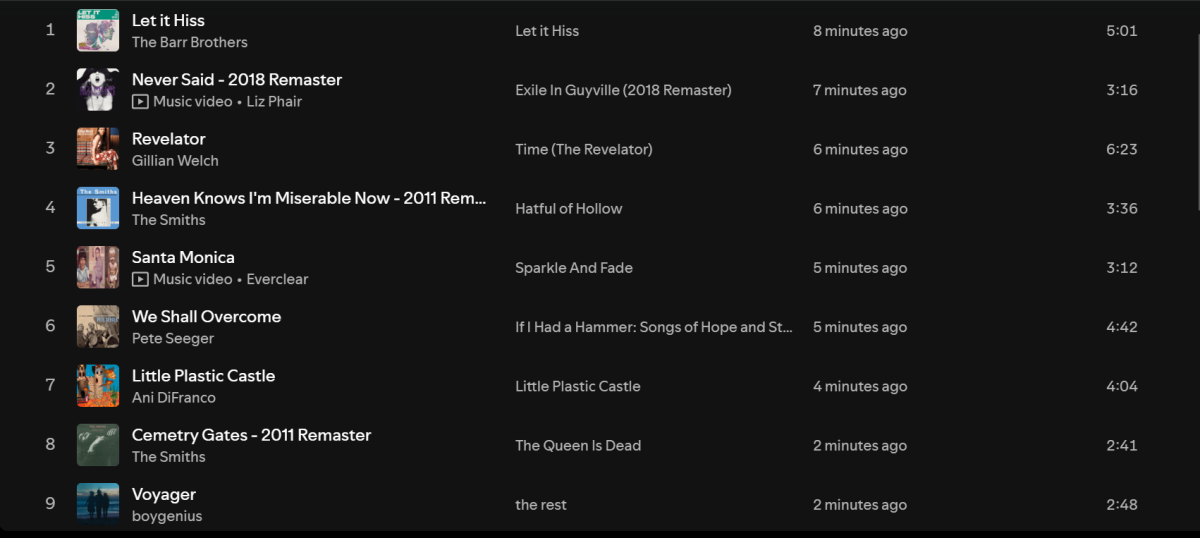
For Dr. Braun, one of those potent moments was moving to San Diego after college. She said it felt like “this big adventure, 3,000 miles away from my family, I found a job, bought a car, just trying to start out my life.” She remembers that “Santa Monica by Everclear was all over the radio,” which came to define that transitory time in her life.
“There are certain albums that I associate with certain periods in my life,” said Dr. Menzer. She remembers that a Pete Seeger tribute album had just been released when her child was small. “I used to sing that baby all of those songs,” she said. “‘We Shall Overcome’ was a big lullaby for that child.”
Not only does music evolve with us, but it also changes us. For some, it functions as an early introduction to political and countercultural movements. For Dr. Braun, early Liz Phair, Ani DiFranco, and Alanis Morissette were an early introduction to more messy and complex public images of femininity, at a time when, as she said, “I wasn’t thinking about myself in political terms.” Even Salt and Pepper set an example as “women who are talking back to some of the sexism inherent in the hip hop industry, and women who are kind of just talking about their experiences navigating relationships and dealing with gossip and trying to figure out a path,” said Dr. Braun. She added, “I always gravitate toward music that resonates for me as somebody living an authentic life, rather than presenting a kind of constructed, perfect version of themselves.” She reflects that Halsey and Phoebe Bridgers are the natural descendants of these artists.
Dr. Helwig remembers that his college experience was defined by the Smiths, the Cure, Depeche Mode, the Violent Femmes, and the Sundays. He was also impacted by 60s rock and roll like The Grateful Dead and The Doors because of their countercultural message. “We would have Smiths listening parties among the English majors in the 80s,” said Dr. Helwig. “The Smiths were, at the time, really doing something different; there was this sense that they thought they had kind of something important to say, even though they felt as many people do, as many teenagers do, at one time or another, kind of marginalized or outside the mainstream.”
Music also defines our mood and how we move through our day. According to Dr. Tevis, “If I want to have a happy beginning to my day, it’s going to be They Might Be Giants. They’re not afraid to be wacky and nerdy, and that appeals to me. They have so many albums and so much music, and a lot of times it zags when you think it’s gonna zig.”
Dr. Menzer said that “when things are really bad, I have a lot of grading to do, I’m out of time, and I’m miserable, I listen to Back in Black, AC/DC. It’s comfort music, and it’s loud, but I don’t have to listen to it… so that might be good for people who have work to do.”
When asked what music they suggest, Dr. Menzer said, “Everybody should listen to the second Boy Genius album.”
“I think Gillian Welch’s album Time (The Revelator). It puts me in a kind of deep dream state. And a lot of good writing can come from that,” said Dr. Tevis.
Dr. Helwig suggests Cemetery Gates by the Smiths, which he plays for his FYW Seminars because of its strong anti-plagiarism message.
“If you want to listen to some like, old angry girl music, ‘Exile Guyville’ by Liz Phair is pretty amazing,” said Dr. Braun. She also said, “I don’t think you can be an English professor and not think Taylor Swift’s lyrics are really skillful.”
Ultimately, these professors’ reflections reveal music as a shared language reaching across generations and experiences. Music is a fundamental part of our memories, daily rituals, and identity.