


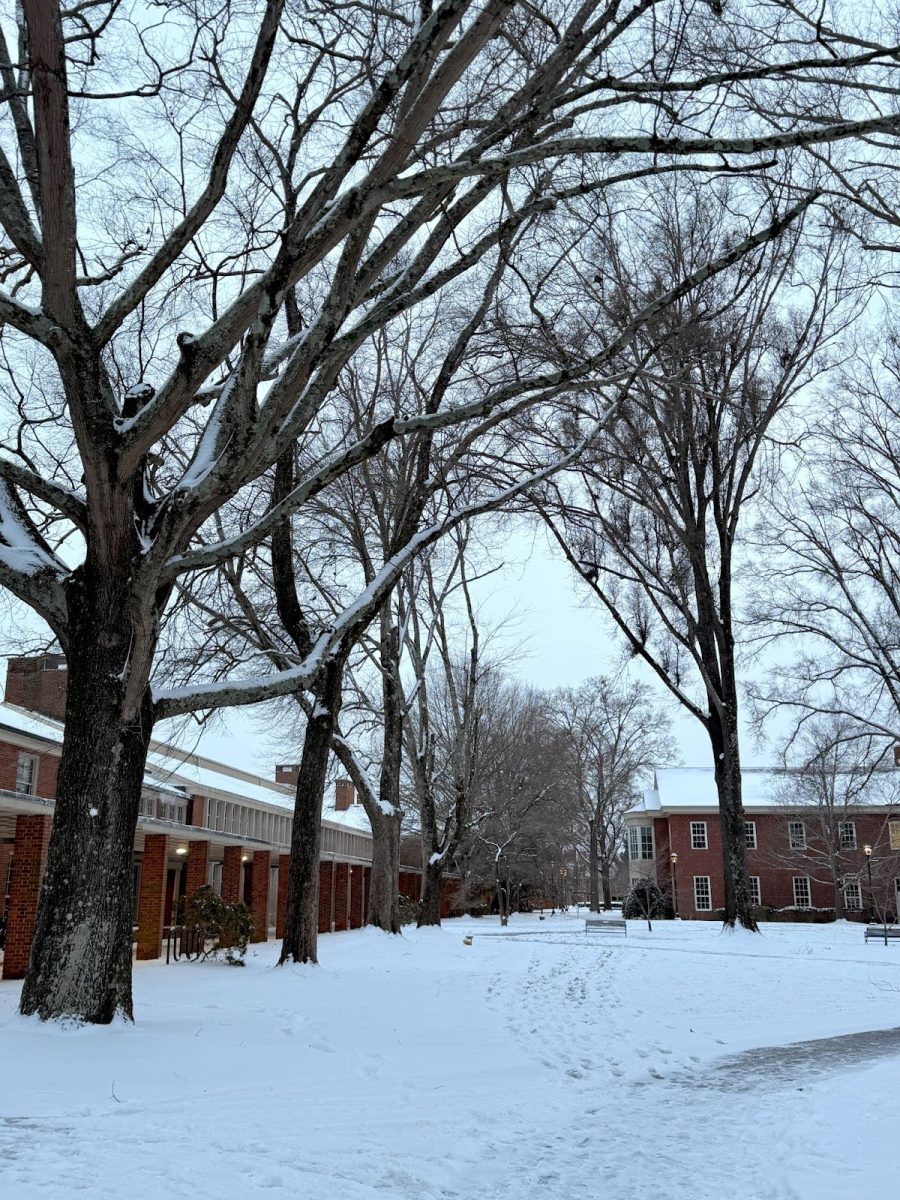





















Year after year, Furman boasts a high ranking in campus beauty, which is used to justify highly intensive landscaping practices, including pesticide use, frequent mowing, over-watering and leaf blowing. This is part of an overly minimalistic and perfectionist attitude toward general maintenance.
It is clear how much time, work and money go into keeping our campus pristine. These landscaping practices aim to signal financial stability to potential investors visiting our campus. Why do we blow leaves almost as soon as they fall if not to show that we have the ability to spend money on unnecessary upkeep?
There are also significant disparities in maintenance and attention. The more people who see a natural area, the more attention and investment it gets. For example, much of North Village is an underutilized natural area. The area surrounding the creek consists of mulch and patches of dirt, lacking aesthetic, recreational or environmental value. The same can be said of the fields surrounding the apartments — numerous acres of unshaded turf grass add nothing to the student experience and don’t serve as an enticing place to congregate.
The mall, on the other hand, is tended to and invested in with great attention because it is the most visible area on campus. It seems strange not to invest in welcoming landscaping practices when we have major projects in the works, like the $40 million renovation of Timmons Arena and the $70 million construction of South Housing.
Unfortunately, the idea of having a livable, communal and environmentally conscious campus has been overshadowed by marketing and reputation. If you walk around campus today, especially near student housing, you don’t see friends gathering outside to study on picnic blankets — you see endless fields of manicured grass and soulless, empty space. In built environments, you will find minimalistic, modern plastic lawn furniture so unwelcoming that they are often unused.
Natural spaces at Furman are so carefully maintained that they lose their character. We mold them into efficient spaces to travel through using pesticides and loud, heavy machinery instead of places that are enjoyable to inhabit. Our institution’s landscaping practices lack creativity, opportunities for community enjoyment and environmental sustainability.
Many sustainability and environment-focused students have worked with the Shi Institute, an underutilized institution on our campus, to implement initiatives such as rain gardens, pollinator areas and self-sufficient natural areas that don’t require maintenance. I ask myself, why is it that students don’t spend more time outside? I think it is because we lack diversity of landscapes.
Changing the types of plants to require less maintenance and revitalizing areas will make them both aesthetically pleasing and useful in college life. Native plants require much less maintenance, and plants like herbs or vegetables would improve the aesthetic of the area while contributing to the ecosystem. For example, planting spearmint acts as a natural pesticide while emitting a pleasant scent. Mini-projects like the wildflower patch across the lake could be recreated on a larger scale to increase the beauty of the area.
Replanting offers students majoring in biology, chemistry and environmental science the opportunity to get hands-on experience and even conduct research. Adding more benches, tables and low-impact structures can allow us to interact more with our surroundings rather than seeing them as a path to get from point A to point B.
While people like Bruce Adams and other members of the Shi Institute are extremely knowledgeable when it comes to permaculture and sustainable groundskeeping, none should play a bigger role in choosing the character of our surrounding natural areas than us, the students. This student involvement itself would serve as a better form of marketing than the obsessive and minimalistic aspects of our current landscape.
As a senior at Furman, I’ve experienced how, time and time again, students have felt excluded from the decision-making process regarding campus policy. As an innovation-focused institution, Furman should empower students to utilize their creativity and skills in creating a campus that best suits their needs and enhances student life.
Changing our current landscape practices to make our campus more welcoming will save the university time and money in the long run while providing students with opportunities for innovation and critical thinking. I envision a future for our campus in which students are more directly involved in curating a home in which they are inspired to live and that prospective students would be excited to become part of.
I hope we ask ourselves this fall, what do we love autumn for if not the crunch of leaves under our feet?
Alexander Underwood • Oct 19, 2025 at 2:34 pm
I like the crunch actually. It’s time for a change.